
0%
Samburu Animals: What You Can See in Samburu National Reserve
So, what are the Samburu animals you can actually expect to see? A lot more than most people think. Samburu National Reserve is home to big herds of elephants, all three big cats, Nile crocodiles, more than 450 bird species and a set of dry-country animals found almost nowhere else in Kenya. We guide in Samburu in every season, so this guide covers every animal you are likely to meet, where in the reserve to look for it, how good your chances really are, and how to plan your days around them.
Quick answer: On a two-night stay in Samburu you can expect elephants, lions, the Samburu Special Five (Grevy’s zebra, reticulated giraffe, Somali ostrich, gerenuk and Beisa oryx), crocodiles, baboons and plenty of antelope. Leopards are seen often along the river. Cheetahs and wild dogs are rarer. There are no rhinos, wildebeest or Great Migration in the reserve.
Samburu National Reserve Wildlife at a Glance
Here is how likely you are to see each animal on a two-night stay with an experienced guide. Sightings are never guaranteed, but this is our honest guide from years of trips.
| Animal | Chance of seeing | Where to look |
|---|---|---|
| Elephant | Very high | Along the Ewaso Ng’iro River, especially at midday |
| Samburu Special Five | High for most, lower for gerenuk | Open scrub and thornbush |
| Lion | Good | Shade near water and along prey routes |
| Leopard | Good, one of Kenya’s best places | Riverine woodland and rocky outcrops |
| Cheetah | Fair | Open scrub and plains |
| Nile crocodile | High | Sandy riverbanks |
| Buffalo | Good | Near water, more often in Buffalo Springs |
| Hippo | Fair | Deeper pools of the river |
| Wild dog | Low, a real prize | Moves widely across the region |
| Rhino | Not in the reserve | Sera Conservancy to the north |
Why Samburu’s Animals Are Different
Samburu sits in Kenya’s hot, dry north, about 350 km from Nairobi. Most of the year it is semi-desert scrub, and the one reliable source of water is the Ewaso Ng’iro River, which runs along the reserve’s southern edge. That shapes everything you see.
- Dry-country species: Animals here are adapted to heat and little water. That is why you find Grevy’s zebra instead of the common zebra alone, reticulated giraffe instead of the Masai giraffe, and the Beisa oryx, which can go long periods without drinking.
- Everything comes to the river: In the dry months the animals are pulled towards the Ewaso Ng’iro, so game viewing is concentrated and easy.
- A small, quiet reserve: Samburu covers about 165 km², and together with Buffalo Springs and Shaba next door the protected area is roughly 500 km². You share sightings with far fewer vehicles than in the Masai Mara.
The Samburu Special Five
These five animals are the reason many people come to Samburu. They are rarely, if ever, seen in southern parks like the Masai Mara or Amboseli, and three of them are classed as endangered.
| Animal | How to recognise it | Conservation status |
|---|---|---|
| Grevy’s zebra | Narrow stripes, white belly, big round ears | Endangered, only a few thousand left, most in northern Kenya |
| Reticulated giraffe | Sharp white net pattern on orange-brown patches | Endangered |
| Somali ostrich | Males have blue-grey necks and legs | Vulnerable |
| Gerenuk | Very long neck; feeds standing on its hind legs | Near threatened |
| Beisa oryx | Long straight horns, black and white face | Endangered |
For where to find each one in the reserve and how many days you need to see all five, read our full guide to the Samburu Special Five.
Elephants: Samburu’s Headline Act
Samburu is one of the best places in Kenya to watch elephants up close. Family herds come down to the Ewaso Ng’iro River in the heat of the day to drink, bathe and cross, often within metres of your vehicle. Watching a herd wade across the river, with the babies holding on to their mothers’ tails, is one of the great sights of a Kenya safari.
The reserve is also the base of Save the Elephants, whose researchers have studied Samburu’s elephants for decades and know hundreds of them by name. Kenya’s 2025 national wildlife census counted more than 40,000 elephants nationwide, up 4% since 2021, as reported by Mongabay.
Our tip: Spend the middle of the day on the riverbank. While other animals rest in the shade, elephants put on their best show.
Big Cats: Lions, Leopards and Cheetahs
- Lions: Prides hunt zebra, oryx and buffalo across the reserve and often rest in the shade near water. Samburu is famous for a lioness the local people called Kamunyak, “the blessed one”, who in 2002 adopted a series of oryx calves instead of hunting them.
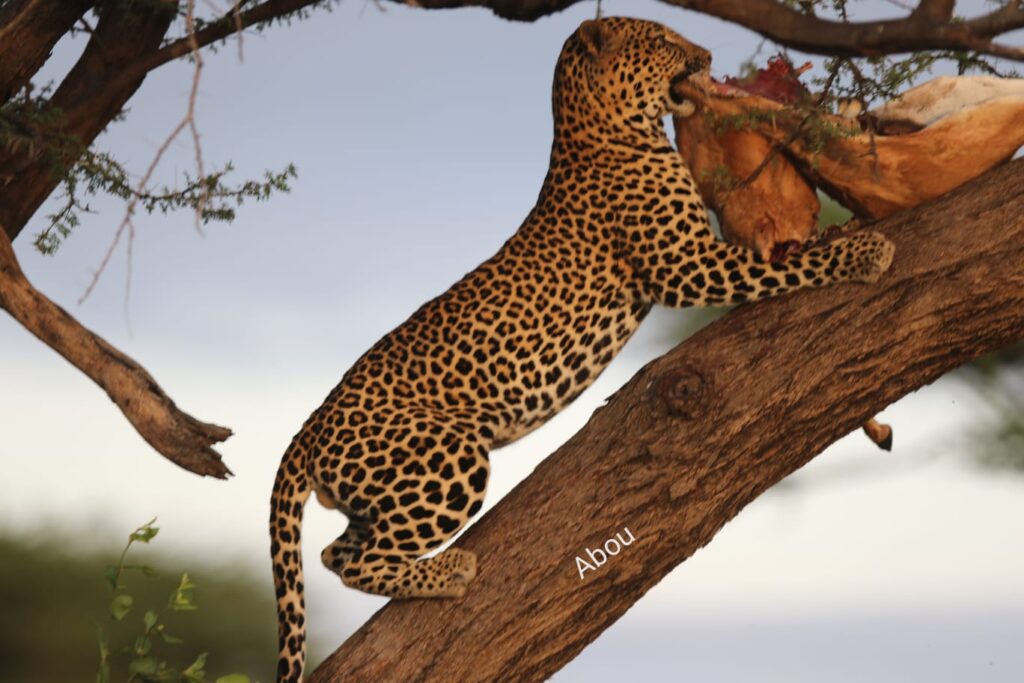
- Leopards: Samburu is one of Kenya’s best reserves for leopard. Look in the doum palms, acacias and rocky outcrops along the river, especially early and late in the day. A good guide checks the same favourite trees every drive.
- Cheetahs: Found on the open scrub and plains, often using termite mounds as lookouts. Sightings are less certain than lions, but very rewarding when they happen.
Other Animals in Samburu: Mammals Beyond the Big Names
- Antelope: Grant’s gazelle, impala, waterbuck and the tiny Kirk’s dik-dik, which you will see in pairs almost everywhere. The shy lesser kudu lives in thicker bush; our guide to the tandala, or kudu, explains how to spot it.
- Buffalo: Found near water and in heavier cover, more often in Buffalo Springs, which is named after them.
- Hyenas and jackals: Spotted hyenas and black-backed jackals are common, especially around kills and at dawn. Striped hyenas also live here but are shy and mostly nocturnal.
- Primates: Olive baboons and vervet monkeys along the river and around the lodges. Keep your room closed; the baboons know how to open doors.
- Hippos: Present in deeper stretches of the river, though sightings depend on water levels.
- Small mammals: Warthogs, dwarf mongooses, unstriped ground squirrels, bat-eared foxes and rock hyraxes.
- Wild dogs: African wild dogs range across northern Kenya and pass through Samburu from time to time. Kenya’s 2025 census found the species had lost roughly half its population in four years, so a sighting is rare and special.
Reptiles
Large Nile crocodiles bask on the sandy banks of the Ewaso Ng’iro and are easy to see from the riverside tracks. You will also see colourful agama lizards on rocks and lodge walls, Nile monitor lizards near the water, and occasionally leopard tortoises after rain.
Birds of Samburu
More than 450 bird species have been recorded in the Samburu and Buffalo Springs area, many of them dry-country birds that are hard to find elsewhere in Kenya.
- Vulturine guineafowl: Bright cobalt blue and unmistakable, often in noisy flocks crossing the track.
- Somali ostrich: One of the Special Five, now treated as a separate species from the common ostrich.
- Golden-breasted starling: One of Africa’s most beautiful starlings.
- Raptors: Martial eagle, bateleur, tawny eagle, pygmy falcon and secretary bird.
- Hornbills and rollers: Von der Decken’s and yellow-billed hornbills, and lilac-breasted rollers on almost every dead branch.
- River birds: Kingfishers, herons and bee-eaters along the Ewaso Ng’iro.
Keen birders can combine Samburu with Lake Baringo, three to four hours away, where more than 470 species have been recorded. See our Lake Baringo bird watching guide, or add a Lake Baringo boat ride for fish eagles and hippos.
Where to Find Samburu Animals: The Main Habitats
- The Ewaso Ng’iro River: The lifeline of the reserve. Elephants, crocodiles, baboons, waterbuck and leopards in the riverside trees.
- Riverine woodland: Doum palms and acacias where leopards rest and monkeys feed.
- Open acacia scrub and plains: Grevy’s zebra, oryx, reticulated giraffe, ostrich and cheetah.
- Thick thornbush: Gerenuk, lesser kudu and dik-dik.
- Dry riverbeds (luggas): Good for spotting tracks and predators moving between areas.
Samburu, Buffalo Springs and Shaba: which has the best animals?
The three reserves share the same wildlife, and animals move freely between them.
- Samburu National Reserve, north of the river, has the most lodges and the classic riverside game drives.
- Buffalo Springs, south of the river, has natural springs that draw buffalo and plenty of open plains for the Special Five.
- Shaba, to the east, is wilder and rockier, with fewer vehicles. It is where Joy Adamson of Born Free spent her last years.
Each charges its own ticket. Our guide to Samburu entry fees explains which you need and what each costs.
Are There Rhinos in Samburu?
Not in the national reserve. If rhinos are on your list, you can track black rhinos on foot with community rangers at Sera Conservancy, north of Samburu, or add Ol Pejeta Conservancy or Lake Nakuru to your trip. Our Lake Nakuru rhino sanctuary guide explains your chances of seeing both black and white rhinos there.
Wildlife in the Conservancies Around Samburu
The national reserve is only the centre of a much bigger landscape. Community conservancies surround it on every side, and many of the same animals move between them. Staying in one, or adding a day trip, gets you experiences the reserve cannot offer.
- Namunyak: A large community conservancy in the Mathews Range, home to the Reteti Elephant Sanctuary, Kenya’s first community-owned elephant orphanage, where local Samburu keepers raise rescued calves. Our Namunyak Safari is built around it.
- Sera: North of the reserve, with a black rhino sanctuary where you can track rhinos on foot with community rangers. This is the answer to the missing fifth of the Big Five.
- Kalama and West Gate: Bordering the reserve, with quieter game drives and, in places, guided walks and night drives that are not allowed inside the reserve.
- Lewa and Ol Pejeta: Two to three hours south, near Mount Kenya, with large rhino populations and some of Kenya’s biggest herds of Grevy’s zebra.
These conservancies are run with the local Samburu communities, and conservancy fees go back to them. When you visit, you are helping make wildlife worth more alive than dead.
Samburu Animals vs the Masai Mara and Amboseli
Samburu is not a replacement for the Masai Mara; it is a different experience. Here is how the wildlife compares.
| Wildlife | Samburu | Masai Mara | Amboseli |
|---|---|---|---|
| Elephants | Excellent, at the river | Good | Excellent, with Kilimanjaro behind |
| Big cats | Good, strong for leopard | Excellent, Kenya’s best | Fair |
| Special Five | Yes, all five | No | No |
| Great Migration | No | Yes, July to October | No |
| Rhinos | No | Rare | No |
| Crowds | Low | High in peak season | Medium |
Many of our guests do both: Samburu for elephants and rare species, then the Mara for big cats. Our Masai Mara vs Amboseli guide compares the two southern parks in detail.
Best Time to See Samburu’s Animals
- June to October: The long dry season and the best wildlife viewing. Animals gather along the river and the bush is thin, so they are easy to find.
- January to February: A short dry spell with excellent game viewing and fewer visitors than August.
- November to December and March to May: The rains turn Samburu green. You get newborn animals, great birding and lower lodge rates, but wildlife spreads out away from the river.
Samburu wildlife month by month
| Months | Season | What to expect |
|---|---|---|
| January to February | Short dry season | Very good game viewing, animals near the river, quieter than August |
| March to May | Long rains | Green, newborn animals, wildlife spread out, lowest lodge rates |
| June to October | Long dry season | Best wildlife of the year, big elephant herds at the river, busiest period |
| November to December | Short rains | Migrant birds arrive, green scenery, good value before the Christmas rush |
Our best time for a Kenya safari guide covers every month across all the parks.
A Typical Day on Game Drive in Samburu
- 6:30am, morning drive: The coolest hours and the best time for lions, leopards and cheetahs on the move.
- 10:00am, back to camp: Breakfast or brunch while the heat builds.
- Midday, the river: If you want the elephant show, this is when to go back out to the Ewaso Ng’iro.
- 4:00pm, afternoon drive: Special Five on the plains, then predators waking up as the light softens.
- 6:30pm, back before dark: Vehicles must leave the game tracks by sunset. Night drives and guided walks are only possible in some of the community conservancies around the reserve, so ask us if you want them.
Photography tip: Bring a zoom of at least 200 to 400mm for leopards and birds, and a bean bag to rest it on the vehicle window. The red dust and harsh midday light are hard on cameras, so carry a cloth and keep your bag closed.
How to See More Animals in Samburu
- Do the midday river drive. Most visitors rest at lunch. The elephants do not, and the river is busiest in the heat.
- Ask your guide about the luggas. Fresh tracks in the dry sand riverbeds tell a good guide where lions and leopards moved overnight.
- Visit both sides of the river. Buffalo Springs, across the Ewaso Ng’iro, is often better for the Special Five on open ground.
- Stay at least two nights. Leopards and cheetahs often take a second or third drive to find.
- Bring binoculars for everyone. Gerenuk and lesser kudu blend into the thornbush, and birds are half the fun here.
- Be patient at sightings. Sitting quietly with a leopard for 20 minutes often turns into the best moment of the trip.
Plan Your Samburu Safari
- How many nights: Two nights gives you four game drives and a very good chance of seeing most of these animals. Three is better for photographers and anyone chasing all of the Special Five.
- Getting there: About 5.5 to 6.5 hours by road from Nairobi via Nanyuki and Isiolo, or about 1 to 1.5 hours on a scheduled flight from Wilson Airport to the airstrips around the reserve.
- Where to stay: Riverside lodges and camps put you closest to the elephants. Samburu Sopa Lodge, Samburu Simba Lodge and Ashnil Samburu Camp are all in our guide to where to stay in Samburu, with prices by budget.
- Our routes: The Namunyak Safari, the 7-day Samburu, Ol Pejeta, Lake Nakuru and Masai Mara safari, and the 14-day Tandala Safari, which also stops at Lake Baringo.
- Budget: Our Kenya safari cost guide shows what park fees and lodges add up to.
For the history, landscape and practical details of the reserve, see our Samburu National Reserve guide.
Why Trust This Guide
This guide is written by the Abou Safaris team, a Kenyan safari operator running trips to Samburu and northern Kenya all year. The sighting chances above come from our own guides’ trips, not a brochure, and our guests rate us 5.0 out of 5 on SafariBookings. You can read more on our guest reviews page.
FAQ: Samburu Animals
What animals can you see in Samburu National Reserve?
Elephants, lions, leopards, cheetahs, the Samburu Special Five (Grevy’s zebra, reticulated giraffe, Somali ostrich, gerenuk and Beisa oryx), buffalo, hyenas, crocodiles, many antelope and more than 450 bird species.
Can you see the Big Five in Samburu?
You can see four of them: elephant, lion, leopard and buffalo. Rhinos are not found in the reserve, but you can track them at nearby Sera Conservancy or visit Ol Pejeta or Lake Nakuru.
What is Samburu National Reserve famous for?
Samburu is famous for the Samburu Special Five, for elephants crossing the Ewaso Ng’iro River, for leopards, and for the lioness Kamunyak, who adopted oryx calves in 2002.
Is Samburu good for leopards?
Yes. Samburu is one of the best places in Kenya to see leopards, especially in the riverine woodland and rocky outcrops along the Ewaso Ng’iro River.
Are there giraffes in Samburu?
Yes, but not the Masai giraffe you see in the south. Samburu has the reticulated giraffe, with a sharp white net pattern, which is one of the Samburu Special Five.
Can you see the Great Migration in Samburu?
No. There are no wildebeest in Samburu. The Great Migration happens in the Masai Mara from about July to October.
Are there wild dogs in Samburu?
African wild dogs range across northern Kenya and pass through Samburu from time to time, but sightings are rare.
What birds can you see in Samburu?
More than 450 species, including vulturine guineafowl, Somali ostrich, golden-breasted starling, martial eagle, bateleur and secretary bird.
Is Samburu better than the Masai Mara for animals?
They are different. The Masai Mara is better for big cats and the Great Migration. Samburu is better for elephants at close range, rare dry-country species and quieter game drives. Many safaris include both.
How many days do you need to see Samburu’s animals?
Two nights is the minimum. It gives you four game drives and a very good chance of seeing elephants, big cats and the Special Five.
See Samburu’s Wildlife With Us
Tell us your dates and group size, and we will plan a Samburu safari with experienced guides, the right lodge and every park fee in one clear price.
Request a quote · see the Namunyak Safari · read guest reviews
Keep Reading: Northern Kenya
- Samburu Special Five: Where to See All 5 in Kenya
- Where to Stay in Samburu: Best Lodges and Camps by Budget
- Samburu National Reserve Entry Fees 2026: Samburu, Buffalo Springs and Shaba
- What Is a Tandala? Kenya’s Greater and Lesser Kudu Explained
- Lake Baringo Bird Watching: 470+ Species, Best Spots and Guide Prices